Discover the Cyclades
Businesses, flavours and experiences across all the islands — choose a category.





Are you a business in the Cyclades?
List it for free and showcase it to thousands of visitors.
List now →
Businesses, flavours and experiences across all the islands — choose a category.
List it for free and showcase it to thousands of visitors.
List now →
Businesses, flavours and experiences across all the islands — choose a category.
List it for free and showcase it to thousands of visitors.
List now →
The island of Perseus and the mines — a Chora that sees everything
In mythology, Serifos is closely tied to the myth of Perseus. Here, inside a wooden chest, Danae and her newborn son washed ashore, and were rescued by the fisherman Diktys. When King Polydektes tried to take Danae by force, Perseus brought the head of Medusa and turned him to stone along with his court — which is why, the myth says, Serifos is so rocky and stony.
In antiquity Serifos was a small but autonomous city-state, with its own currency and walls. It took part in the naval Battle of Salamis against the Persians and belonged to the Athenian Alliance. The island was already known for its ores — iron and copper — mined since ancient times.
In Byzantine and medieval times, Serifos, like all the Cyclades, passed to the Duchy of the Aegean after the Fourth Crusade (1207) and was ruled by Italian feudal lords. It was then that the Castle was built at the summit of Chora, for protection against pirates. Later the island passed to the Ottoman Empire and was incorporated into the Greek state after the Revolution of 1821.
Modern Serifos's history was shaped by iron mining. From the late 19th century, large mining companies operated mines at Mega Livadi and Koutalas, employing hundreds of workers under harsh conditions. In August 1916 the historic miners' strike broke out, which was suppressed with bloodshed — one of the first organized labor struggles in Greece and a milestone for the labor movement. The mines closed in the mid-20th century, leaving behind the unique industrial landscape we see today.
Monasteries, castles, ancient towns and hiking routes.
At the summit of the Chora rock, the medieval castle stands with a panoramic view over the Aegean. Around and within its ruins unfolds the old settlement, with the chapel of Agios Konstantinos at the highest point.
A row of traditional windmills along the ridge above Chora — a landmark feature and an ideal spot for sunset.
The central square of the Upper Village, with the imposing neoclassical building of the old Town Hall (1908), one of the finest public buildings in the Cyclades.
A fortified 16th-century monastery near Galani, dedicated to the Archangels. It preserves notable frescoes, a carved wooden iconostasis and relics, resembling a small fortress amid the wild landscape.
In Chora, it houses objects, tools and mementos of everyday Serifiot life, illuminating the island's agricultural and mining past.
The industrial landscape of the iron mines that operated from the 19th century until the mid-20th century. Galleries, industrial buildings and the impressive loading bridge from which ore was loaded onto ships still survive.
At Mega Livadi, a memorial to the bloody miners' strike of August 1916 — one of the first major labor struggles in Greece, with workers killed.
A cave with stalactites and stalagmites near the bay of Koutalas, also known as the "Cave of the Cyclops," with traces of use since antiquity.
Ruins of a Hellenistic tower (c. 4th–3rd century BC) made of white marble, in the area of Kentarchos — evidence of the island's ancient fortification and organization.
At the summit of Chora, next to the Castle, with a view stretching across the whole island and sea — the highest point of the settlement.
In the settlement of Panagia, one of the oldest Byzantine churches on the island, with elements from the early Christian period.
In Chora, the archaeological museum houses sculptures, inscriptions and finds from ancient Serifos, set in a neoclassical building near the square.
An impressive throne-shaped rock formation near Koutalas, which local tradition links to the Cyclops and the neighboring cave.
Ruins of an ancient fortified acropolis on a steep hill, with sections of walls that testify to the island's ancient habitation and defense.
Thermal springs with sulphurous waters near the coast, long known for their healing properties.
Serifos's cuisine is simple, austere and authentic, based on the products of the wild land — pulses, aromatic greens, cheeses and fish.
Accommodation, restaurants, activities and local products of the island.
Locations come live from the official Cyclades business directory.
 Accommodation
 Accommodation
 Accommodation
 Accommodation
 Accommodation
 Accommodation
 Accommodation
 Accommodation
 Entertainment
 Entertainment
 Activities
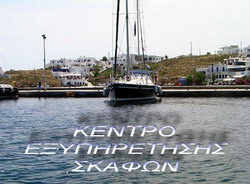 Activities
 Local Products
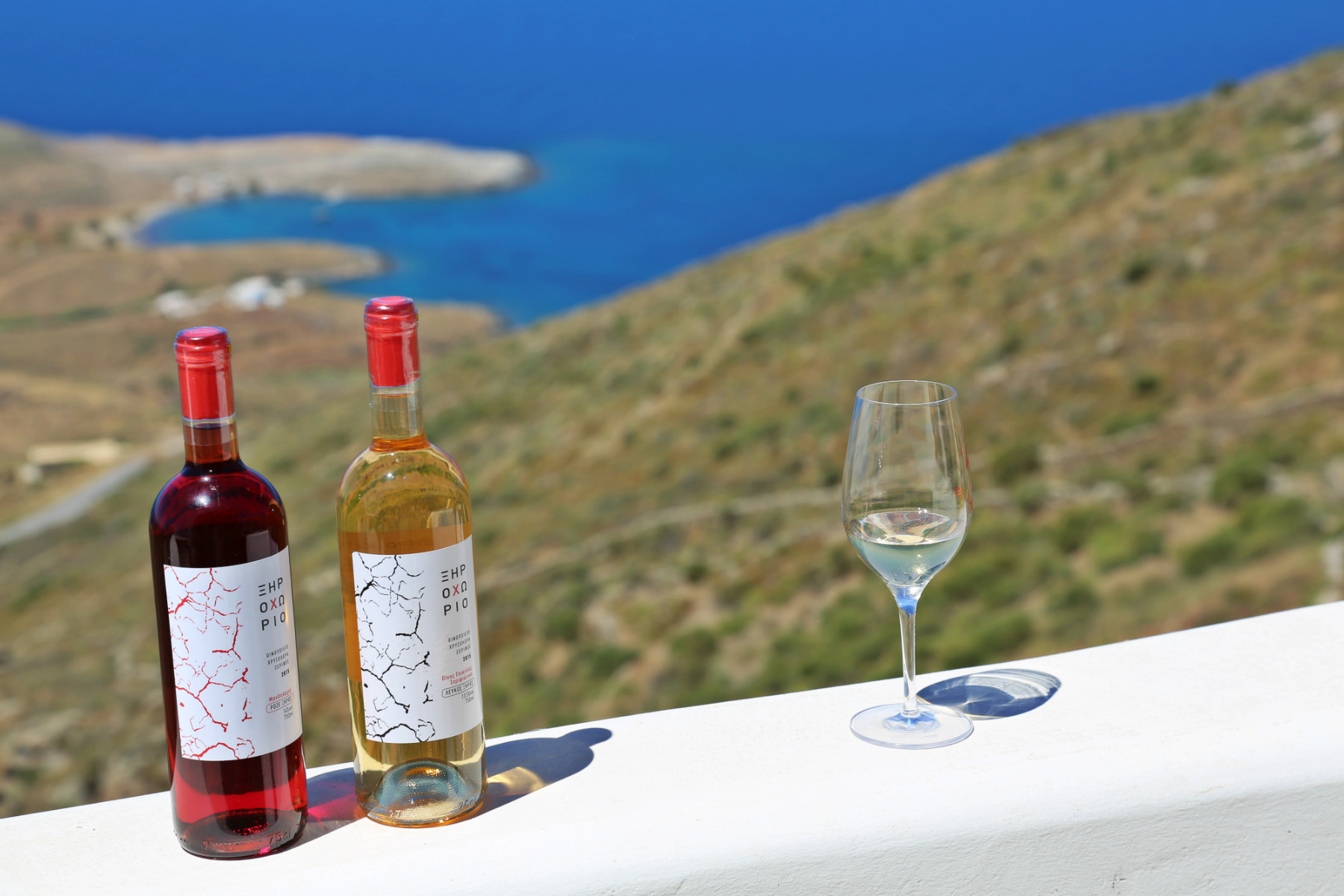 Local Products
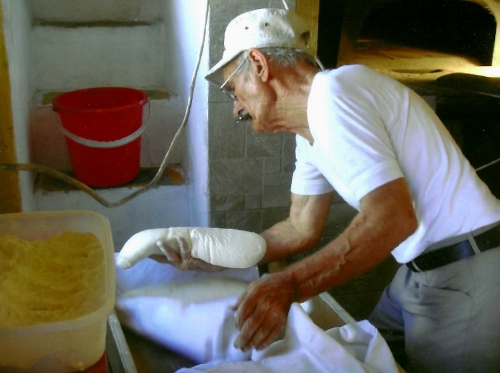 Local Products
 Local Products
The harbor beach, large and organized, with taverns and every amenity right beside the island's ferry-boat life.
Next to Livadi, a sandy beach with shady tamarisk trees — one of the island's most popular and convenient.
Considered one of the finest beaches in the Aegean — shallow turquoise waters and fine golden sand just outside Livadi.
A double stretch of sand on either side of a small peninsula with the picturesque chapel of Agios Sostis — whichever way the wind blows, there's always a sheltered side.
A large, open beach in the north, with dense tamarisks for shade — remote and peaceful, set in a lush green ravine.
A hidden stretch of sand with crystal-clear waters, ideal for those seeking quiet far from the crowds.
A sheltered bay in the south, with sand, pebbles and calm waters — scenic and relaxing, with a tavern at its edge.
A quiet southern beach with coarse sand and pebbles, in a calm, isolated setting.
A large beach in the bay of the old mines, with the loading bridge and industrial buildings still standing above the waves.
A secluded cove in the southwest, near the mines and the cave of the same name, with shallow waters and very few visitors.
A remote pebble beach with crystal-clear waters at the southern tip, for those seeking absolute tranquility.
An open, wild stretch of sand in the east, with little shade and a sense of isolation.
A large sandy beach with tamarisks at the northern tip of the island, remote and peaceful, with a tavern beside the water.
A secluded, open stretch of sand south of Livadi, without shade or facilities, with deep azure waters for those seeking isolation.
A large, open sandy beach in the south, deserted and atmospheric, with golden sand and little shade.
A sandy beach with tamarisks on the east coast, below the village of Kallitsos, quiet and picturesque with a few taverns.
A quiet stretch of sand near Livadi, at the edge of the bay, with shallow waters and a laid-back atmosphere.
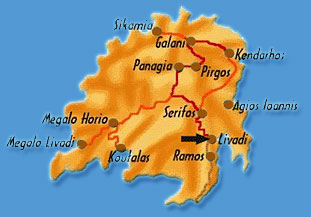
Serifos has no airport. The harbor at Livadi is connected by ferry to Piraeus (about 2.5–4.5 hours, depending on the vessel) and to the neighboring islands of the western line — Kythnos, Sifnos, Milos and Kimolos.
A local bus connects Livadi with Chora and the nearby beaches. For remote beaches and the mines, renting a car or scooter is the most convenient option, while several secluded beaches are reached by footpath or caïque.
Combine Serifos with the neighbouring Cyclades.
Plan your own trip to Serifos, day by day, tailored to you — with the help of the aiTripPlanner.