Discover the Cyclades
Businesses, flavours and experiences across all the islands — choose a category.






Are you a business in the Cyclades?
List it for free and showcase it to thousands of visitors.
List now →
Businesses, flavours and experiences across all the islands — choose a category.
List it for free and showcase it to thousands of visitors.
List now →
Businesses, flavours and experiences across all the islands — choose a category.
List it for free and showcase it to thousands of visitors.
List now →
The quiet side of the caldera — the "old Santorini"
Thirasia was once part of a single volcanic island, the mythical Strongyli (or Kallisti), together with present-day Santorini. Around 1600 BC the cataclysmic Minoan eruption blew apart the volcano's center, collapsed the island's interior and formed the immense caldera; thus Thirasia was cut off and remained on the western side of the crater.
Thirasia holds a distinct place in Aegean archaeology. Already in 1866–1867, when the island was being quarried for the famous volcanic "Thiraic earth" used in the construction of the Suez Canal, prehistoric buildings and finds came to light — a discovery that preceded the major excavation of Akrotiri in Santorini and first drew scholarly interest to the prehistoric civilization of the region.
In antiquity the island lay in the shadow of the powerful Ancient Thera. After the Roman and Byzantine periods, with the Frankish rule Thirasia passed, together with Santorini, under Venetian dominion and was incorporated into the sphere of the Duchy of the Aegean, all the while enduring pirate raids that forced its inhabitants to build far from the sea.
Under the Ottoman Empire and later, within the modern Greek state, Thirasia remained a poor but proud rural island, its economy based on vineyards, wine and volcanic products. As neighboring Santorini transformed into a world-famous tourist destination, Thirasia was gradually depopulated — and precisely for this reason it preserved intact the authentic look of "old Santorini".
Monasteries, castles, ancient towns and hiking routes.
The rim of the vast volcanic crater, with an incomparable view toward Nea and Palaia Kameni, the volcano and Santorini — the same legendary sight, but in complete tranquility.
The small capital hanging on the cliff, a labyrinth of all-white lanes, arched houses and the quietest sunset of the entire caldera.
The paved path with around 250 steps connecting the little harbor of Korfos with Manolas — the traditional ascent, on foot or by mule.
The island's central monastery of the Virgin Mary, near Agrilia, with a major religious festival on August 15th that draws the whole island.
At the highest point of Thirasia, the Monastery of Profitis Ilias offers a panoramic view over the whole caldera and the Aegean.
The main church of Manolas, with its distinctive blue dome, on the central square-balcony overlooking the caldera.
Traditional dwellings carved into the soft volcanic rock, an example of the distinctive architecture born from the caldera landscape.
In the Kimisi area, prehistoric ruins came to light as early as the 1860s, during the quarrying of volcanic "Thiraic earth" — finds that predate even those of Akrotiri.
The low, coiled "kouloura" vines on the black volcanic soil, which produce the distinctive Assyrtiko wine of the volcanic complex.
The quiet rural settlement with old stone houses and chapels, where life moves as it did decades ago.
A chapel of Saint Demetrios in the rural settlement of Potamos, one of the dozens of picturesque country churches scattered across Thirasia's quiet hinterland.
A chapel of the Virgin 'Giatrissa' (the Healer) in the area of Potamos, dedicated to the miraculous, healing grace of the Virgin Mary.
The church of the Presentation of the Virgin in Agrilia, built in 1887, one of the most important religious monuments of the island's southern rural settlements.
The cuisine of Thirassia is the authentic cuisine of the volcano: simple, full of flavor, and based on the unique products gifted by the black, arid volcanic soil.
Accommodation, restaurants, activities and local products of the island.
Locations come live from the official Cyclades business directory.
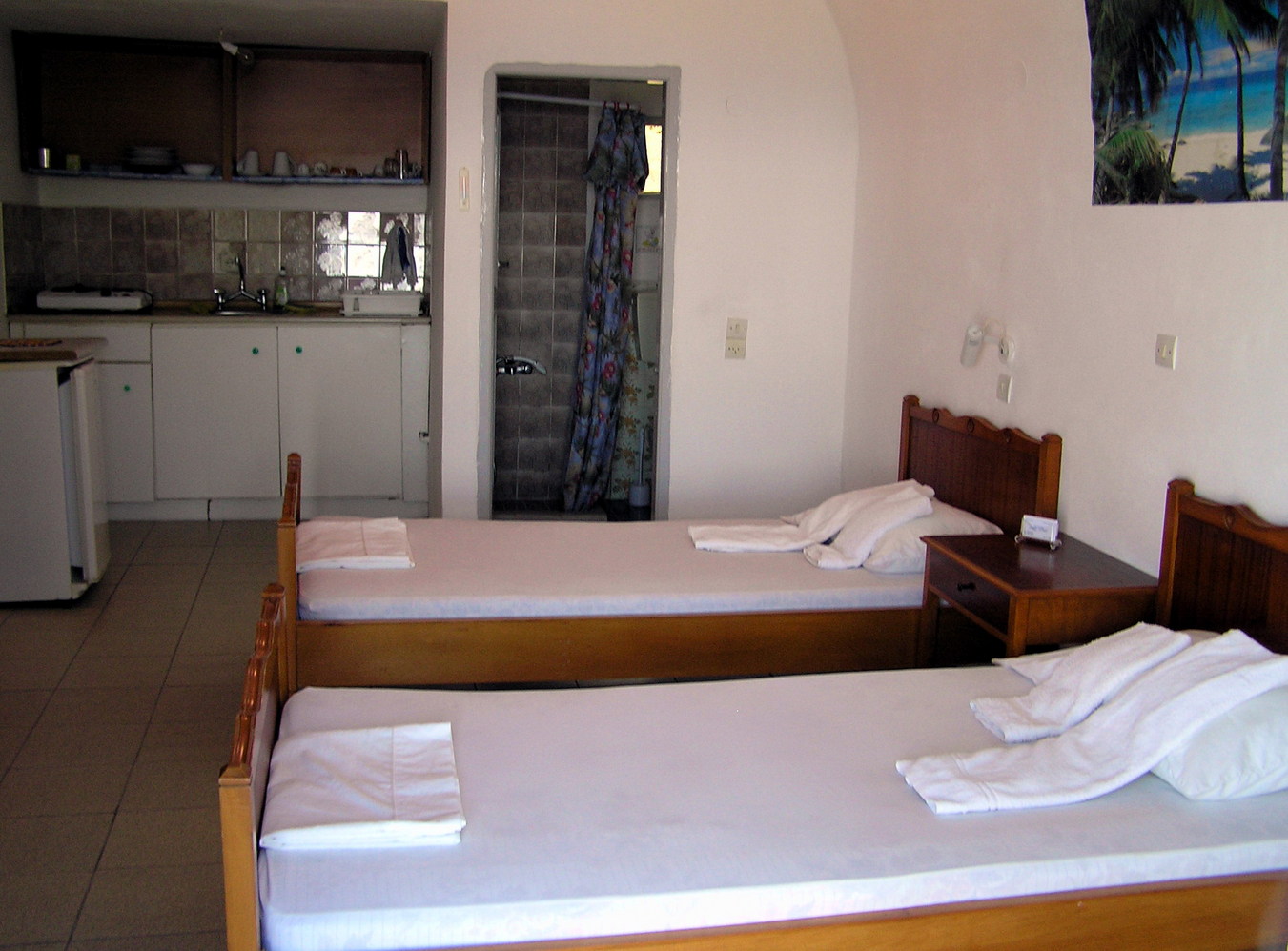 Accommodation
 Local Products
The island's main beach and northern port, with dark pebbles and a few taverns right by the water — this is where the ferries and small boats from Santorini dock.
Thirasia's most picturesque spot: a small harbor at the base of the cliff, below Manolas, with pebbles, fishing boats and calm, clear waters.
Isolated, quiet beach with the chapel of the same name — according to one theory, it was this Agia Eirini (Saint Irini) that gave "Santorini" its name (Santa Irini).
Thirasia can only be reached by sea from Santorini: by small ferry from Athinios to Riva, or by boat from Ammoudi in Oia to picturesque Korfos (~15–20 min) — the most atmospheric route, through the caldera.
The island is very small and is explored mainly on foot, along footpaths and steps; a single road connects Riva with Manolas and the settlements, while from Korfos you climb to the main town by steps or by mule.
Combine Thirasia with the neighbouring Cyclades.
Plan your own trip to Thirasia, day by day, tailored to you — with the help of the aiTripPlanner.